Holes in the Experience

You’ve probably lived this scenario: You buy a product online — one you’re anxious to receive. The e-commerce vendor sends you a confirmation saying the product has been shipped and giving you a tracking number. You click on the supplied link with the tracking number you just received only to receive this message:
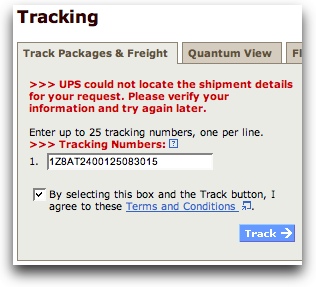
UPS could not locate the shipment details for your request. Please very your information and try again later.
[Note: UPS is not unique with this problem. FedEx has exhibited the same behavior and I’m betting the other major shippers all have flavors of it.]
Now, if you look carefully at this example, you’ll see there is a valid UPS number. It was delivered by the shipper to the user.
The user doesn’t need to verify the information — it’s perfectly fine.
The problem is what’s going on at UPS. The user’s mental model is the product is in the shipping system. And it is, in that the shipper has requested a number to attach to a package.
But it hasn’t made it to the server (dare we say “legacy mainframe”?) which serves the tracking system. There’s a lag between the systems.
And this is where the frustration begins. The e-commerce vendor wants to deliver a seamless experience, but here, out of the gate, we’ve discovered a big hole. The vendor tells me my package is on the way, but the shipper disavows any knowledge of it. The product (already paid for) is in some sort of shipping limbo, which is exactly what the tracking system was put on earth to avoid — it’s supposed to tell you where things are and not deliver this funny way of saying “We have no clue what you’re asking for.”
What could UPS do? Well, they could change the message to be more honest. They could say, for example, “You’ve tracked a valid package number, but our systems are slow and we haven’t moved the information we gave your vendor to give you into the computer that lets us tell you where it is. Sucks, doesn’t it? Imagine how miserable it must be for us!”
Or, they could do the right thing and upgrade their systems to give faster feedback. I’m sure that’s neither cheap nor easy, otherwise they would’ve done it already.
The result of not doing either is this hole in the user’s experience. If the user is patient enough (and tries again), the hole will be plugged. But, until then, they are left wondering if something has gone wrong when, in fact, nothing has. Not a good way to start a relationship, is it?